 Français
 Italiano
 Español
 Português PT
 Nederlands



There are no more items in your cart

 English GB
Blazers, Jackets

The suit is an essential piece in a man's wardrobe. Its jacket, a versatile top, can be paired with a whole range of suitable shirts, T-shirts and trousers. Beware of style mistakes, though. A jacket can send out very different messages that have a direct impact on your image. To feel "good" in your jacket, take a few minutes to read through our advice and tips.
When to wear a suit jacket
It is the circumstances that dictate the dress code: wearing a given jacket in a given place at a given time. Everyone knows that a suit is essential for occasions such as weddings and evening events.
The tuxedo jacket you wore to a gala evening, on the other hand, is likely to make you look overdressed at the office. To avoid a "ceremonial" effect at work, favour matt fabrics in understated colours such as grey or navy. The same applies at a job interview in a bank or a law firm, where the full suit is implicitly required, set off with a tie (blue for preference) that is neither too narrow nor too wide.
At an after-work drink in a club or a bar, you will make your look far more relaxed by rolling up the sleeves. Also take care to remove your tie so you blend in better with the crowd. Avoid the sequinned jacket in flashy tones, however, unless it is a themed evening with a 1970s disco feel.

How to choose your suit jacket
If it is the occasion for wearing the jacket that dictates your choice, it is your body shape that must have the final say. Always favour a jacket that is correctly fitted to your chest and sides.
A jacket that is too big will make you look "lost" in your suit. It is better to go for a fitted cut that will show off your slender silhouette. Also avoid a jacket that is too long. Fronts that hang below the start of the seat make the silhouette look stocky by lengthening the torso and shortening the legs.
Also take the time to check how the shoulders fall: the seam must line up with the point where they end. The vent at the back is another essential element, for practical as well as aesthetic reasons.
As for the sleeves, they should stop just above the wrists so that one or two centimetres of shirt show. Finally, your jacket must keep its shape when you fasten it. A jacket that pulls at the buttons is a sign that it is too small for you.
How to button it
Just like the suit waistcoat or the cardigan, the way a jacket is buttoned matters enormously for an impeccable look. Double-breasted jackets, which generally have inner fastenings, are not unbuttoned, unlike the single-breasted jacket.
With a single-breasted two-button jacket, you should fasten every button when you are standing and undo the bottom one when you sit down. With a single-breasted three-button jacket, fastening the first is optional, the second is compulsory and the third is forbidden. But if you are seated, leave all three buttons undone to avoid unwanted creases. Note that in the professional world, a fully buttoned jacket suggests a lack of flexibility and self-confidence.
Show in this way that you have an eye for detail and a good understanding of the language of clothing. What is more, pay attention to your accessories. Opt for colours that go with everything when it comes to your shirt.
Since you need several of them, choose it in white, with or without stripes, and in plain sky blue. Avoid wearing a checked shirt with a suit, however. Also favour professional bags that flatter your outfit and forget the backpacks, which will undo all your efforts.


How to take in a suit jacket
As everyone has their own body shape, a made-to-measure fit is not always a given after a purchase. Even if the shoulders sit well, alterations are often needed, especially around the waist. The more resourceful among you can do this yourselves by following a few basic instructions.
Manufacturers often leave a little margin in the seam allowances, giving you the option of altering the stitching. First measure your chest and divide it by two to get your size. For a chest measurement of 96 cm, for instance, the appropriate size is 48. Add an ease allowance of 12.5 to 15 cm.
Then spread this ease across each dart: one for each side, two at the front and one for the curve of the back. Start by unpicking the darts of the jacket and its lining. Bring the panels together and take in the excess centimetres to slim your silhouette. Tack the panels with a basting stitch and try the jacket on. If the fit is right, you can finally use the sewing machine for the final stitching.
Which suit jacket with jeans
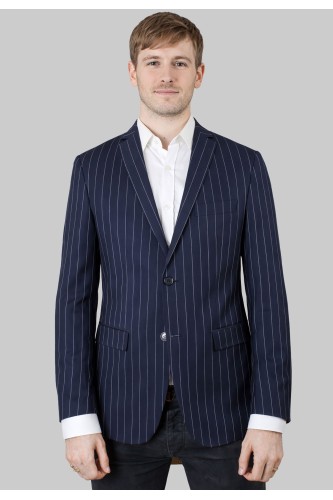
A jacket is not reserved solely for suit trousers. You can even treat yourself to a cheap suit jacket bought without the trousers. Just like a lounge jacket or a blazer, it is easy to wear with jeans. Combining these two great timeless pieces of men's fashion creates an effect that is at once smart, youthful and relaxed. Take care, however, to match them properly in terms of colours and accessories. Favour a fitted top in understated shades with navy, dark grey or black jeans. You can wear it with a shirt or even a T-shirt tucked neatly into the jeans. Avoid faded denim so as to respect the smartness of the jacket, unless you are deliberately playing with contrasts for a rebellious effect. In that case, show that it is a question of taste and style rather than a lack of money: choose a belt with a statement buckle, loafers, boots or high-end trainers. Leave lace-up shoes for the matching suit, otherwise you will look like a novice with no sense of style.